Career orientation plays a crucial role in promoting social well-being. It helps individuals identify their skills, interests, and values, which in turn can guide them towards finding fulfilling and meaningful careers. Having a sense of purpose and direction in one’s career can contribute to increased job satisfaction and overall life satisfaction, leading to improved mental and emotional health. Moreover, a clear career path can also enhance financial stability, reducing stress and providing a sense of security. In short, career orientation can have far-reaching effects on an individual’s wellbeing, impacting not only their work life but also their personal and social lives.
The role of the teacher in career orientation.
Teachers have a unique opportunity to influence the social well-being of their students through their role in guiding career orientation. By providing students with guidance and support as they navigate the process of choosing a career, teachers can help them identify their strengths, interests, and values, which can then inform their decisions about the types of careers they pursue.
Additionally, teachers can help students develop important skills, such as effective communication and problem-solving, which are critical for success in any career. By creating a supportive and encouraging environment, teachers can instill in their students a sense of confidence and self-worth, and help them believe in their ability to achieve their goals and succeed in their chosen careers. Ultimately, through their guidance and support, teachers can have a lasting impact on the social well-being of their students, helping them find fulfilling and meaningful careers that positively contribute to their overall happiness and success in life.
Inspiration for a lesson plan
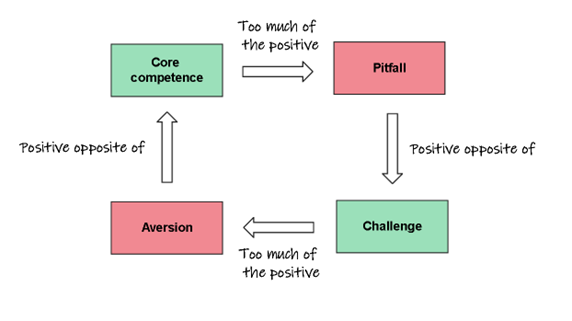
During the meeting / lesson you introduce the core competence matrix (see top) and the table with competencies. (see below)
Next let have the students write down several competences that they attribute to themselves. Let other students complement this list
Let them choose one of the competences and fill in the matrix to get to know what their pitfalls are, their challenges and their aversions.
For example: When someone is a creative thinker (core competence), their pitfall could be that the are chaotic. Which makes that they are less organized,resulting in their challenge to try being more organized. Because creative people are often not organized this could result in an aversion of people that are ver focused on being well organized. People that are only doing things according to plans and find it harder to think of creative solutions to problems.
By getting to know their key competences, pitfalls, challenges and aversions, students are more likely to pick a career in which those competences are used to its full potential. Also it helps with developing empathy.
Tip: When the students and/or teacher struggle to determine key competences, family and friends of the student can be asked.
| Competency | Meaning of competency | Example | Example of profession in which this competency is important | |
| 1 | Being observant | Noticing and acting on signals given by people, organisation and society. | Is quick to notice if there is something up with another person | Relationship therapist, Bodyguard, Trendwatcher |
| 2 | Taking the initiative | Acting on one’s own initiative; making the most of opportunities; undertaking something, even if it entails risk | Often takes the initiative | Entrepreneur, Salesperson, Activity Leader |
| 3 | Analysing | Understanding complex information; making connections; drawing conclusions | Quickly understands the crux of a difficult problem | Researcher, Detective, System Designer |
| 4 | Deciding | Weighing things up and reaching a decision | Manages to make the right decision in complex situations | Judge, Director, Interim Manager |
| 5 | Creating | Coming up with new ideas, approaches or solutions | Often comes up with new ideas | Advertising Executive, Industrial Designer, Interior Designer |
| 6 | Planning and organising | Scheduling activities and resources (human and non-human) in order to achieve an objective | Is good at estimating what’s required to implement a plan | Planner, Conference Organiser, Traffic Controller |
| 7 | Persisting | Persisting, even if there are setbacks | Goes the distance, even in the face of adversity | Cyclist, Social Worker in an addiction clinic |
| 8 | Responding flexibly | Doing something you’re not used to doing or you weren’t intending to do, as the situation requires | Manages to adapt if circumstances change | Holiday Rep, Stand-up Comedian, A&E Doctor |
| 9 | Performing under pressure | Being effective in situations of pressure, e.g. time pressure, risk, emotional strain | Stays in control of himself/herself in chaotic situations | Police Officer, Fighter Pilot, Football Referee |
| 10 | Verbal communication | Understanding others and being understood in verbal communication | Has a good sense of what the other person means | Solicitor, Interviewer, Psychotherapist |
| 11 | Written communication | Understanding others and being understood in written communication | Is capable of communicating well in writing, even with people who are very different | Journalist, Editor, Literary Critic |
| 12 | Helping | Offering time, effort and resources to achieve someone else’s/other people’s goals | Has a good understanding of what other people need and endeavours to offer this | Social Worker, Personal Coach, Physiotherapist |
| 13 | Networking | Building, maintaining and making the most of a network | Knows a lot of people | Estate Agent, Headhunter, Lobbyist |
| 14 | Monitoring | Verifying whether one’s own or someone else’s actions or products are satisfactory | Regularly checks whether work is on schedule | Accountant, Auditor, Inspector |
| 15 | Leading | Exerting influence and control | Is highly persuasive | Manager, Trade Union Leader, Politician |
| 16 | Autonomy and self-development | Extracting lessons from experiences and steering one’s own development process | Works on own development purposively | Increasingly important in nigh on all roles and professions |
Links:
- https://www.studiekeuzelab.nl/ – Dutch website that helps students to pick a follow up study after high school
- https://www.123test.com/competencies-list/ Competence list